
WIMBA prosthetics are intended for dogs who are missing part of a limb due to various reasons, such as amputation (e.g., tumors, injuries), accidents, or congenital defects. Each prosthesis is individually designed based on a 3D scan of the patient's stump and healthy limb. For this reason, the appearance of the prosthetics may differ from the one shown in the visualization.
For the thoracic and pelvic limbs, we provide different products. If your patient's weight is over 45 kg, we will contact you to verify the order.
Available Products
For Thoracic Limb: Below Elbow Prosthesis
For Pelvic Limb: Below Stifle Prosthesis
Please note: We do not provide prosthetics for full limb amputation.
Scanning and Placing Orders
Please familiarize yourself with the scanning instructions before scheduling a meeting with your patient. In some cases, additional information or media, such as videos, X-rays, or measurements, may be required to create the product.
Knowing what will be required for upload to WimbaAPP is crucial for properly planning the scanning visit.
Examples of condition, when missing the part of the limb can occur:
- Missing part of a limb due to amputation (e.g., tumors, injuries),
- Missing part of a limb due to accident,
- Missing part of a limb due to congenital defect.
- Missing part of a limb (different reason)
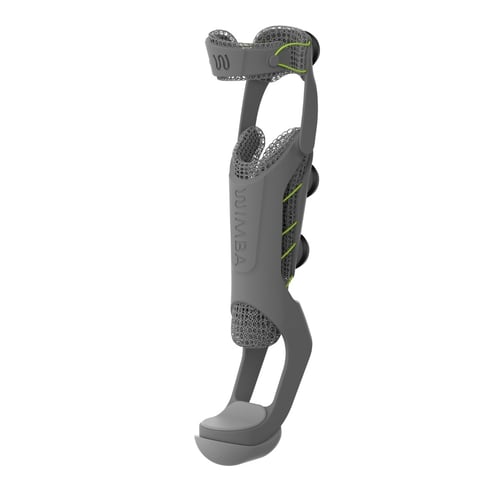
WIMBA Prosthesis Pro Below Elbow
The WIMBA Prosthesis Pro Below Elbow is designed for patients with thoracic limb amputations below the elbow joint.
This prosthesis covers all amputation levels below the elbow, including:
-
Below the elbow (radius and ulna)
-
Below the carpus (wrist)
-
Metacarpal and phalangeal levels
Regardless of whether the stump ends at the radius/ulna, carpus, metacarpus, or phalanges, the Below Elbow prosthesis is the appropriate solution for your patient.
WIMBA Prosthesis Pro Below Stifle
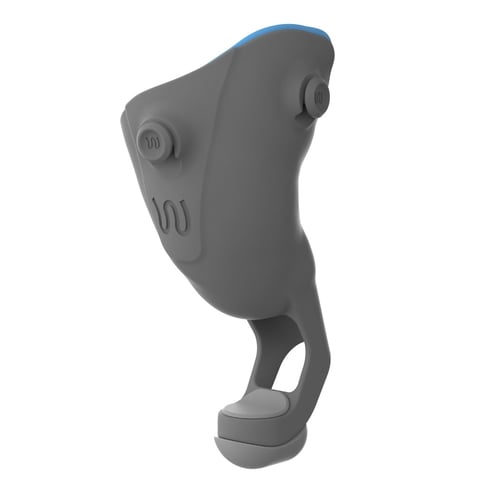
The WIMBA Prosthesis Pro Below Stifle is intended for patients with pelvic limb amputations below the stifle (knee) joint.
This prosthesis covers all amputation levels below the stifle, including:
-
Below the stifle (tibia and fibula)
-
Below the tarsus (hock)
-
Metatarsal and phalangeal levels
Whether the stump ends at the tibia/fibula, tarsus, metatarsus, or phalanges, the Below Stifle prosthesis is the correct choice.
How to Order WIMBA Prosthesis Pro
During placing an order we will ask you for two scans and manual measurements of stump and healthy limb, x rays and videos showing gait of your patient and video showing stump itself. What is more, we will ask you about some details of the stump.
-
A. Video Scan (WimbaSCAN)
Use WimbaSCAN to capture your dog's stump and healthy leg with your phone in two different videos. Please remember to use a patterned wrap, proper lighting, and to turn on the highest available video quality, ideally 10-20 seconds long.
Guide to Wrapping the Dog: [click here to watch the video]
The entire stump should be tightly wrapped with a patterned wrap. To minimize the risk of the wrap sliding down, ensure it is wrapped at least once around the abdomen (for a rear limb prosthesis) or around the chest (for a forelimb prosthesis). The thinner the wrap layer, the better.
Guide to Performing Video Scan
While taking videos remember that the stump needs to be still: let the dog stand on 3 legs to decrease the need of the dog to stabilize itself (by moving, especially the stump).
-
B. Prepare Two Scans
- Healthy leg wrapped tight in patterned vet wrap.
- Stump wrapped in patterned wrap, healthy leg without vet wrap (or in a different color for long haired dogs), standing on the floor (circulate around both leg and the stump).
If on scan 2 the stump is moving, please create another scan:
- Stump wrapped in patterned wrap: healthy leg without vet wrap (or in a different color for long haired dogs), stump hand held to reduce movement.
-
C. Manual Measurements
We have minimized the number of manual measurements to make the measurement process as simple as possible, while still ensuring it is conducted properly and provides all the essential information needed to create the device.
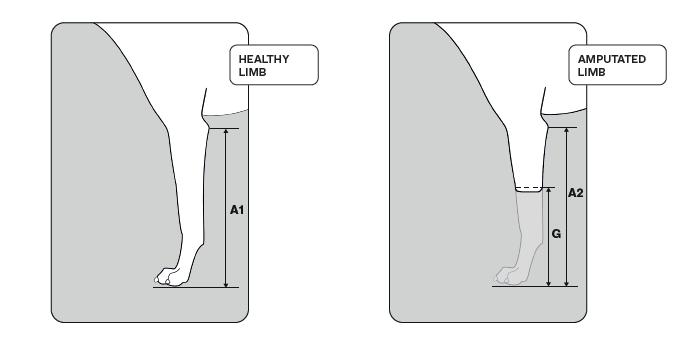
WimbaSCAN is an extremely precise tool that allows for scanning and accurately measuring a limb. For the sake of patient well-being and accuracy, we kindly ask that manual measurements also be taken, but only those necessary to validate the 3D scan.
Measurements needed for WIMBA Prosthesis Pro Below Stifle:
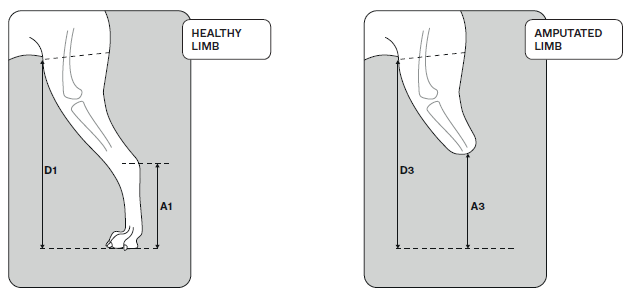
Measurement card:
WIMBA Prosthesis Pro Below Stifle
Measurements needed for WIMBA Prosthesis Pro Below Elbow:
-
D. CT/X-RAY*
You can upload directly to the app or send to us X-ray (required) or CT scans (optional - best would be in DICOM). We recommend sending the files via WeTransfer.
-
E. STUMP DETAILS
We will ask about specific details of the stump: date of amputation (if known), stump characteristics, pinpoint sensitive areas. Please, add here any information that can be important during designing prosthesis.
-
F. DOG’s GAIT VIDEO
Provide two videos showing the dog from the medial (left and right), front, and back aspects while moving. Ensure that the dog displays the same gait in both videos and that this reflects his natural way of movement.
Video 1: The dog should walk parallel to the camera from one side to the other and back, showing both the left and right sides.
Video 2: The dog should walk away from the camera and then back towards it, showing both the back and front views.
Note: The camera should be placed at the dog's level. Allow the dog to walk in a straight line and as naturally as possible to demonstrate the natural movement of your patient.
Prosthesis Checklist for Veterinary Professionals:
- Scan of the stump
- Scan of healthy leg
- Manual measurements: stump
- Manual measurements: healthy leg
- Xray or CT scan
- Video gait 1: medial aspect
- Video gait 2: back and forth
- Stump description
- Video of stump
- Pet parent guide - give access/printed
- photos,
- videos,
- a description,
- information on what can be improved (what can be shifted / enlarged / reduced). All changes should be provided with specific values, e.g. in centimeters.
- creating a positive association with the prosthesis (classical conditioning),
- learning to stand and load the residual limb,
- learning how to put on and remove the prosthesis.
- small dogs with very short residual limbs may be too small for our prostheses (due to technological limitations),
- if the dog is small and the amputation is planned just below the elbow or the knee, we strongly recommend contacting our prosthetist to assess whether the remaining limb will be suitable for a Wimba prosthesis at all.
IMPORTANTIf you have any questions before placing an order, please complete Case Consultation. The final decision regarding the feasibility of producing a prosthesis is made only after we receive complete and correct information and measurements (including the WIMBA Scan).
IMPORTANTEach prosthesis is made individually.The appearance of the prosthesis may differ significantly from the visualizations presented on the website.