
At WIMBA Go, we’re growing to meet your needs. By collaborating with exceptional specialists who trust our orthoses as part of their treatment and rehabilitation plans, we’ve optimized our processes to develop products faster and with significantly less data.
Thanks to these advancements, we can now create a personalized orthosis using just a few measurements and two photos of your patient's limb.
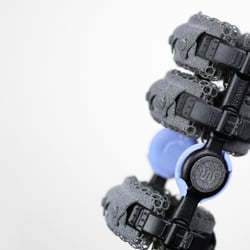
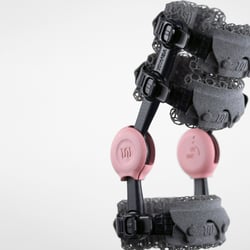
WIMBA Go Orthoses are available for:
|
 |
|
 |
WIMBA Go Carpus Orthoses come in three types:
- Standard
- Mini
- Nano
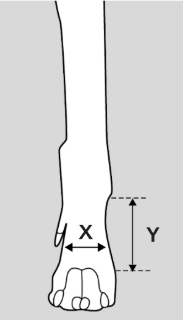
How do I know which type fits my patient?
|
Measurement |
Standard |
Mini |
Nano |
|
Distance from the middle of the joint to just proximal of the lateral/palpable metacarpal heads (Y) |
>5.35 cm |
<5.35 cm >3.60 cm |
<3.60 cm >2.75 cm |
|
Minimum circumference (X) |
8.5 cm |
6 cm |
4.5 cm |
NOTE: Distance below the joint (Y) is based on the information where the distal end of the lowest strap will land with reference to the center of the hinge + 0.6 cm for insert:
WIMBA Go Orthotics Indications
WIMBA Carpus Orthosis GO is indicated for dogs with mild to moderate carpal instability or lameness in the sagittal plane — including hyperextension, post-surgical support, preventive care in tripods and obese dogs, and cases requiring controlled range of motion during rehabilitation. Ordered using manual measurements, no scanning required.
WIMBA Tarsus Orthosis GO follows the same principles for the tarsal joint — supporting dogs with hyperextension, instability, or altered weight distribution in mild to moderate cases. As with the carpal device, it supports movement in one plane and is fitted via guided measurements.
Both devices are custom-made, modular, and water-resistant, with adjustable tokens to set full, partial, or blocked range of motion.
WIMBA will not take responsibility for the device not working/not supporting the limb in conditions outside of indications.
Wimba Carpus Go playlist with measurements:
WIMBA Go Tarsus Orthoses come in two types:
- Standard
- Mini
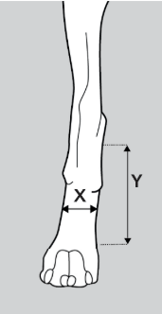
How do I know which type fits my patient?
|
Measurement |
Standard |
Mini |
|
Distance from the middle of the joint to just proximal of the lateral/palpable metatarsal heads (Y) |
>5.35 cm |
<5.35 cm >3.60 cm |
|
Minimum circumference (X) |
8.5 cm |
6 cm |
NOTE: Distance below the joint (Y) is based on the information where the distal end of the lowest strap will land with reference to the center of the hinge + 0.6 cm for insert:
|
Where the distal end of the lowest strap will land with reference to the center of the hinge |
||
|
Standard: |
Mini: |
Nano: |
|
4.750 cm |
3.000 cm |
2.125 cm |
What Will Be Needed to Take Measurements?
Everything you need for measurements can be easily purchased anywhere in the world. Please prepare the following:
- 1 - Soft tailor’s tape
- 2 - Goniometer
- 3 - Caliper (recommended, how to use calliper)
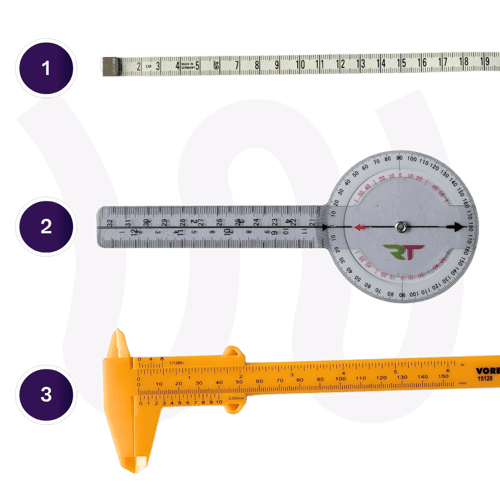 Additionally, have your phone ready to take photos and download the relevant measurement cards.
Measurement Cards
Download the appropriate measurement card for your patient’s needs:
Photos for Validation
To ensure proper fitting of the orthosis, attach two clear photos of the limb where the device will be fitted. The photos must be of high quality, with the limb in the center of the image. It is essential that the dog naturally places weight on the paw during the photos.
Include photos taken:
- From the front
- From the side
Refer to the examples below for proper positioning:
%20(1).jpg?width=330&height=330&name=carpal%20(1)%20(1).jpg)
%20(1).jpg?width=330&height=330&name=tarsal%20(1)%20(1).jpg)
To Consider before Deciding on WIMBA Orthotics Go
Consider |
Why |
|
Multiple mobility conditions at the same time |
Any complicated cases should be carefully thought through, submitting your case is highly advised |
|
Long time usage steroids |
Possibility of progression of laxity |
|
Problems with mobility due to issues with contralateral limb |
Consider bilateral orthoses |
|
Weight that is not strictly indicated |
Combined with very high activity = probability of device failure |
|
Tripods |
Is the overload on resembling limbs mild and can be addressed with Go solution or moderate: please see WIMBA Pro solutions |
|
Obese dogs |
Is the overload on limbs mild and can be addressed with Go solution or moderate: please see WIMBA Pro solutions |
|
Cats |
Behavioral issues are more common with cats |
|
Skin issues: Decubitus Ulcers, Contact Dermatitis (Allergic or Irritant), Infections (Bacterial or Fungal), Pododermatitis, Skin Necrosis, or other. |
Higher probability of abrasions |
|
Dew claw present |
Higher probability of abrasions and behavioral problems due to discomfort |
Additional files: